- LifeOS
- AI workflow architecture
- source of truth
Building LifeOS
Why I keep the source of truth in plain files and use AI as the thinking layer around them.
I’ve been working on a personal AI operating system I call LifeOS.
It started as a practical problem: I keep using AI for different parts of life, but the context is always scattered. Health is in one place. Work is somewhere else. Food logs are in a chat. Finance decisions live in notes. Screenshots, PDFs, conversations, and plans all exist, but nothing really connects.
So I’m building a structure around it. Not an app. Not a dashboard. A set of plain Markdown files where each part of life has its place.
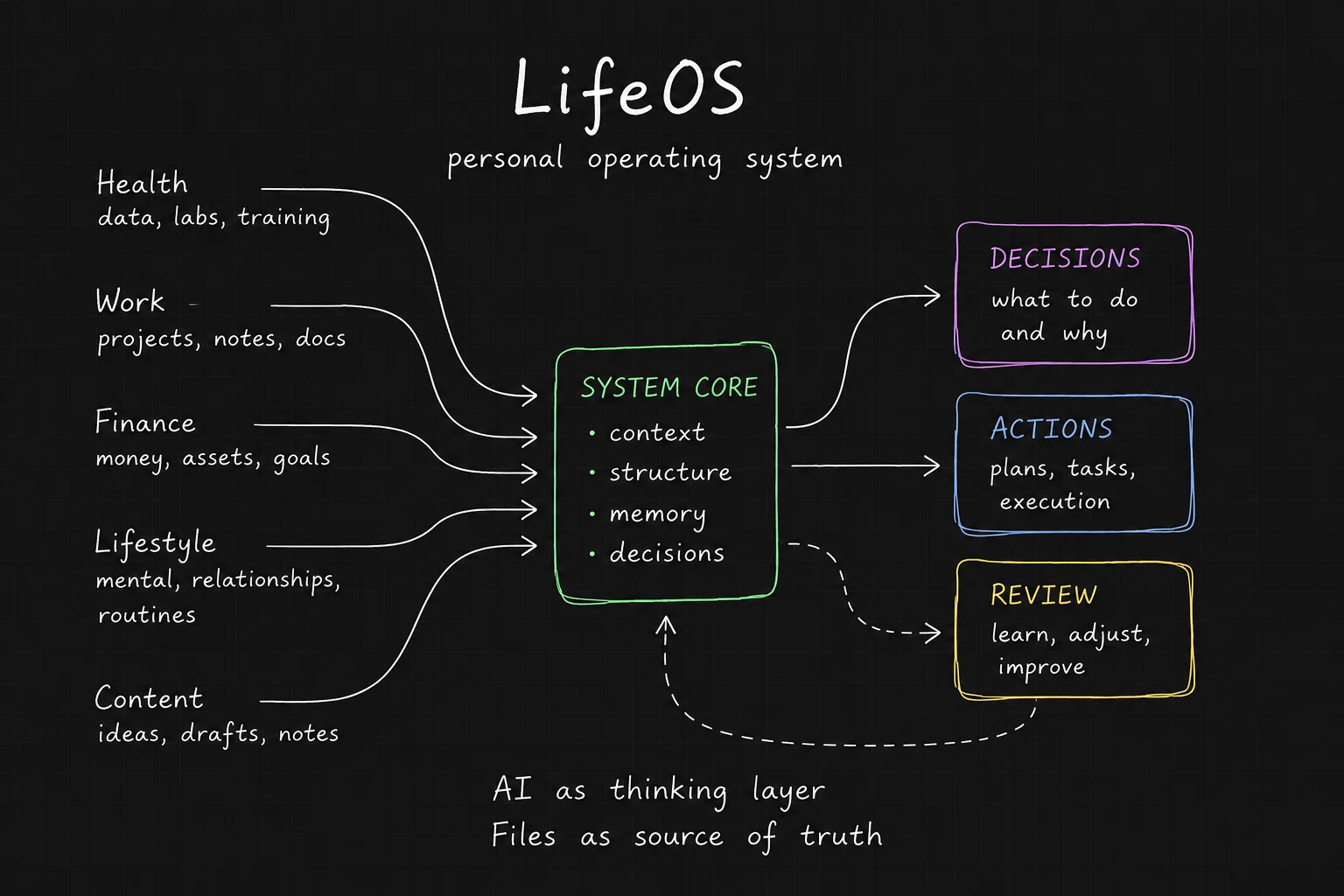
The files are the source of truth. AI is the thinking layer.
That distinction matters. I don’t want AI to become the place where my life is stored. I want it to read the right context, think with me, and help turn messy inputs into better decisions.
From screenshots to decisions
In the morning, I can drop in a few Apple Watch screenshots: sleep, HRV, resting heart rate, interruptions, and maybe a note about the previous day.
The system turns that material into a recovery log and then into a simple training decision: train, modify, recover, or rest.
Nothing dramatic. But useful. Apps already track health data. The interesting part is what happens after the data is understood.
Raw evidence arrives in the easiest available form.
The evidence is interpreted against recent history.
Readiness changes the next action instead of ending at a score.
The training plan can then affect food, schedule, workload, or recovery. The value is not another number. It is context moving between real decisions.
Less dashboard. More context.
I think a lot of AI products will move this way: health coaches, finance coaches, work assistants, and creative copilots. Each one will optimise one piece of life.
But real life does not stay inside one category. Sleep affects training. Training affects food. Work stress affects recovery. Money affects lifestyle decisions. Creative direction affects time.
The harder problem is not another app. It is the private context underneath.
That is what I’m building. Still early. Still rough. Still partly manual. But already useful.
Related: My LifeOS Fits Into Seven Domains shows the current top-level structure.